
Blog
Why Was My Building Permit Rejected? Florida Fixes (2026)
Permit rejected in Florida? Learn the common reasons, how to read review comments, and how to resubmit correctly to get your project moving again.
Key Takeaways
-
Rejected permit applications in Florida are usually correctable plan-review results, not final denials; read every comment and fix each item before resubmitting.
-
Under Florida Statutes §553.79, code-based denials must cite the specific noncompliant plan features and applicable code sections, so your comments should point to exactly what needs fixing.
-
The most common rejection causes are incomplete paperwork (unsigned forms, missing fees, wrong file formats) and plans that don't demonstrate Florida Building Code compliance.
-
Missing sealed structural or MEP engineering documents is a frequent trigger, especially for additions, structural changes, and solar arrays on older roofs.
-
Confirm the correct jurisdiction and permit type before filing, since addresses near city limits can fall under county authority and trade permits may not cover the full scope.
-
Resubmit only after responding to every open comment, clearly identifying revisions, and following the portal's file naming and upload workflow to avoid a second rejection.
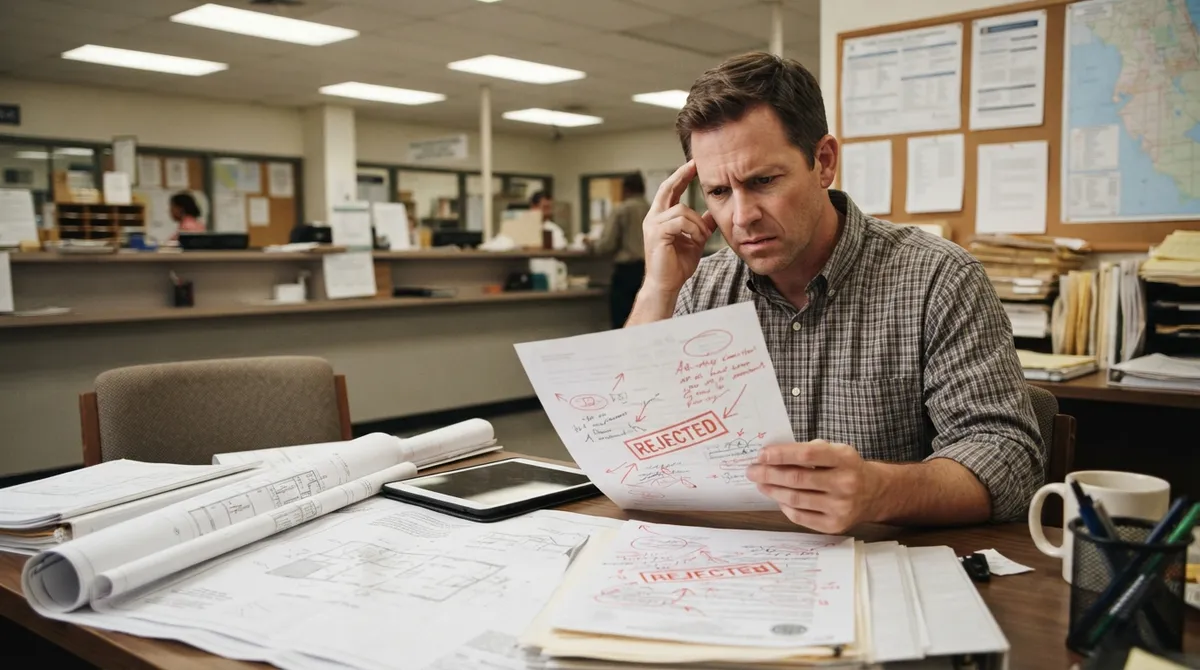
You hit submit, crossed your fingers, and then the email landed: your permit application was rejected. Take a breath. If you're asking yourself why was my building permit application rejected, you're in very good company, and the news is usually better than it feels in the moment.
In Florida, a rejected or returned application is most often a correctable plan-review result, not a permanent "no." A reviewer found something missing, unclear, or out of line with the Florida Building Code or local rules, and they want it fixed before work begins. Whether you're a general contractor with a crew on standby, a solar company chasing install dates, a realtor racing a closing, or a homeowner dreaming up a new addition, the path forward is the same: read the comments, fix every item, and resubmit the right way.
This guide walks you through the most common rejection reasons, what your comments are really telling you, how to resubmit, and when it makes sense to call in backup. Let's get your project moving again.
First, Don't Panic: Rejected Usually Means Fixable
Here's the reassuring part. Under Florida Statutes §553.79, when a local enforcing agency denies a permit for code noncompliance, it must identify the specific noncompliant plan or project features and cite the applicable code chapters and sections. In other words, the department can't just say "no" and leave you guessing. Your comments should point to exactly what needs attention.
Many jurisdictions treat the first review as a back-and-forth. Tallahassee's published process, for example, sends the applicant a resubmit notice and asks for corrected plans or documents plus responses to open comments before the next review cycle. Other Florida departments work similarly, though the details vary by portal and county.
So think of rejection as a punch list. Your job is to clear it, item by item.
The Most Common Reasons a Florida Permit Application Gets Rejected
Rejections fall into two broad buckets: administrative problems (something is missing) and substantive problems (the plans don't show code compliance). Here's how they typically break down.
| Rejection Category | What It Usually Means | Typical Fix |
|---|---|---|
| Incomplete application | Required forms, signatures, fees, or supporting documents are missing | Upload the missing items in the format the portal requires |
| Plans don't show code compliance | Drawings lack details proving compliance with the Florida Building Code | Revise sheets, add details, notes, or calculations |
| Structural deficiencies | Loads, connections, or framing details are missing or unclear | Provide sealed structural drawings or an engineer letter |
| MEP issues | Electrical, mechanical, or plumbing information is incomplete | Add load calcs, riser diagrams, equipment schedules |
| Energy code gaps | Missing energy forms or insulation and glazing data | Submit the required energy compliance documentation |
| Missing outside approvals | Zoning, land-use, or other government approvals aren't in place | Obtain the approval first, then attach proof |
1. Incomplete or Missing Paperwork
This is the single most frustrating (and most fixable) cause. What counts as a complete submittal varies by project type and by local building department, so a package that sailed through in one city can bounce in the next county over. Common culprits include:
- Unsigned or outdated application forms
- Missing owner or contractor authorization
- Absent notice-of-commencement or contractor registration details
- Incorrect or unpaid fees
- Missing product approvals or specification sheets
- Files uploaded in the wrong format or with the wrong names
If you work across multiple jurisdictions, our building department lookup tool can help you confirm which office actually controls your address.
2. Plans That Don't Demonstrate Code Compliance
A reviewer isn't just checking that drawings exist. They're checking that the drawings prove compliance with the Florida Building Code and any local laws or ordinances. Typical comments touch on structural design, life safety, egress, wind-load requirements, energy provisions, and fire separation.
Florida's wind and flood requirements add extra layers. Coastal and high-velocity hurricane zones demand specific connection details and product approvals, and a drawing that looks fine in a calm inland county may be flagged in a coastal one.
3. Missing Engineering or Sealed Drawings
Many projects need signed and sealed structural or MEP documents, and a plan set without them is a quick route to a rejection. Additions, structural modifications, solar arrays on older roofs, and anything involving load changes often require engineering. If you suspect this is your issue, our structural engineering and engineer letters services are built for exactly this kind of comment.
4. Other Approvals Weren't Secured First
Sometimes the building plans are perfectly fine, but another approval has to come first. Depending on the property and the work, that can include zoning or land-use approval, environmental review, or other government sign-offs. Always confirm requirements with the local jurisdiction before you apply, because the building department generally can't issue a permit until those boxes are checked.
5. Wrong Jurisdiction or Wrong Permit Type
Near city limits, it's surprisingly easy to file with the wrong authority. A property with a city mailing address may actually sit in unincorporated county territory, or vice versa. Filing the wrong permit type (say, a trade permit when the scope really needs a full building permit) also triggers returns.
How to Read Your Plan-Review Comments
Your comment letter is your roadmap. Here's a simple way to make sense of it, whether you're a seasoned GC or a first-time homeowner.
- Download every comment and attachment. Reviewers often mark up the plans themselves, so don't rely on the summary email alone.
- Sort comments by discipline. Group them into building, structural, electrical, mechanical, plumbing, zoning, fire, and energy.
- Match each comment to a code section. Because Florida law expects code-based denials to cite the relevant sections, look for those references and read them.
- Flag the ambiguous ones. If a comment is vague, contact the reviewer or plans examiner for clarification before you revise.
- Assign an owner to each item. Decide who fixes what: you, your designer, your engineer, or a permitting partner.
A little organization here saves you from the dreaded second rejection, which usually happens because one comment got overlooked.
How to Resubmit a Rejected Permit Application in Florida
Resubmittal procedures are jurisdiction-specific, so always follow your portal's instructions. That said, most Florida departments expect a version of these steps.
- Respond to every open comment. Skipping even one is the fastest way to get bounced again.
- Revise the plans and documents. Update sheets, add details, attach calculations, and make sure everything is signed and sealed where required.
- Identify your changes clearly. Many departments want revisions clouded or listed, and some require a comment-response letter.
- Use the required file format and naming. Some portals reject uploads that don't follow their naming rules.
- Upload through the correct portal workflow. Resubmitting through the wrong channel can leave your revisions sitting unseen.
- Track the new review cycle. Keep an eye on status changes and respond quickly to any new notices.
If this feels like a lot, that's because it is. Our revisions and resubmittals team handles this exact process every day, and our plan review coordination keeps comment responses organized and on schedule.
How Long Does Review and Resubmittal Take?
There's no single statewide answer, and it would be misleading to quote one. Timelines depend on the jurisdiction, project type, and current workload. Statewide rejection rates also aren't published in a way we can responsibly cite, so be wary of anyone throwing around a percentage.
What the statutes do offer is clarity for private-provider reviews. Under Florida Statutes §553.791:
| Scenario | Timeline Under §553.791 |
|---|---|
| General case: local official's initial action on a qualifying application | Up to 20 business days to issue the permit or provide a written deficiency notice |
| Certain single-trade reviews for one- or two-family dwellings | 5 business days |
| After a timely deficiency notice | The review period is tolled while deficiencies are resolved |
| After a revision is submitted | Generally the remainder of the tolled period plus 5 business days to issue the permit or give a second notice |
Deficiency notices under that statute must identify code-specific deficiencies, which keeps the process focused and transparent. For a broader look at what to expect, see our guide on how long a building permit takes in Florida, and learn how a private provider compares to the building department if speed is your top concern.
Who Gets Hit Hardest, and How to Avoid It
Different readers run into different rejection traps. Here's a quick snapshot.
| Who You Are | Common Rejection Trigger | Smart Prevention |
|---|---|---|
| General contractors | Inconsistent plan sets across disciplines, missing sealed drawings | Coordinate structural, MEP, and architectural sheets before filing |
| Solar companies | Roof structural verification, electrical one-lines, product approvals | Include engineer letters and complete equipment data up front |
| Realtors and investors | Unpermitted prior work, open permits, missing records | Run permit research early in the deal timeline |
| Homeowners | Hand-drawn or incomplete plans, wrong permit type | Use code-compliant drawings and confirm the jurisdiction first |
| Architects and designers | Missing energy forms, life-safety details | Run a pre-submittal checklist for each jurisdiction |
If you're a contractor juggling several counties, our guide to general contractor permitting in Florida lays out the bigger picture, and solar teams will want to read up on Florida solar permit timelines.
When the Rejection Is Tied to Something Bigger
Occasionally, a rejection is a symptom of a deeper issue. If your application was flagged because of unpermitted prior work, an expired permit on the same property, or a code violation, you'll need to resolve that first. These situations are especially common in real estate transactions, where a permit hold can threaten a closing.
In those cases, it helps to know your options early:
- After-the-fact and expired permit help for work that was never permitted or permits that lapsed
- Code compliance violation support when a notice is attached to the property
- Urgent permit rescue when a denial, stop-work order, or closing deadline is on the clock
If you want a deeper dive into this specific question, we also cover it in why was my building permit rejected from a few more angles.
Should You Hire a Florida Permitting Service?
You can absolutely handle a resubmittal yourself, and plenty of people do. But a permitting partner earns its keep when:
- You've already been rejected more than once
- The comments reference structural, wind-load, or MEP issues you can't resolve on your own
- You're filing in several jurisdictions and can't keep each portal's quirks straight
- A closing, crew schedule, or install date is at stake
- You need sealed drawings fast and don't want to chase an outside engineer
That's where 1 Contractor Solutions comes in. We're Florida's outsourced permitting department, serving all 67 counties, with in-house drafting and sealed engineering so reviewer comments get fixed fast instead of bouncing between vendors. We're also a licensed private provider, which means we can often perform plan review ourselves rather than leaving you in the county queue. And if you'd like to see how other clients feel about working with us, you can see what our 1 Contractor Solutions customers say on Google.
A Simple Pre-Submittal Checklist to Avoid the Next Rejection
Prevention beats rework every time. Before you file or refile, run through this list:
- Confirm the correct jurisdiction and permit type for the address
- Verify every form is current, complete, and signed
- Check that plans are consistent across all sheets and disciplines
- Include sealed engineering where the scope calls for it
- Attach product approvals, specs, and energy documentation
- Secure any zoning or other required approvals first
- Follow the portal's file format and naming rules
- Prepare a comment-response letter for resubmittals
Want to stay connected for more Florida permitting tips? You can follow us on LinkedIn or follow us on Facebook, and you can browse the full range of permitting services we offer.
Final Thoughts: Turn the Rejection Into a Green Light
So, why was my building permit application rejected? Almost always because something was missing or the plans didn't yet prove code compliance, and almost always, that's fixable. Read the comments carefully, address every item, resubmit through the proper channel, and keep an eye on the new review cycle. A rejection is a detour, not a dead end.
If you'd rather hand the whole thing to a team that does this every day, we're ready to jump in. Get a free quote and let's turn that rejection notice into an approved permit and a project that's moving again.
FAQs
Why was my Florida building permit application rejected?
Most often it's because required forms, plans, fees, or approvals were missing, or because the plans didn't show compliance with the Florida Building Code or local rules. Your review comments should spell out exactly what to fix, and under Florida Statutes §553.79, code-based denials must cite the specific noncompliant features and code sections.
Can I resubmit a building permit application after it's rejected in Florida?
Yes, and happily so! A rejection is usually a correctable plan-review result, not a final denial. Respond to every open comment, upload revised documents in the format your jurisdiction requires, and follow your portal's resubmittal process.
Can a Florida building department deny a permit without explaining why?
Not when the denial is for code noncompliance. Florida Statutes §553.79 requires the agency to identify the specific noncompliant plan or project features along with the applicable code chapters and sections, so you know exactly what needs correcting.
Do I need zoning or other approvals before applying for a building permit?
Often, yes. Depending on your property and the type of work, zoning, land-use, or other government approvals may need to be in place before a building permit can be issued. It's smart to confirm requirements with your local jurisdiction before you apply.
Should I hire a Florida permitting service to fix and resubmit my application?
It's a great option if you've been rejected more than once, the comments involve structural or MEP issues, or a deadline is looming. A permitting service with in-house drafting and sealed engineering, like 1 Contractor Solutions, can correct plans, coordinate review, and handle resubmittals so you can stay focused on the project.
We do this work every day across all 67 Florida counties. Call (866) 314-6931 and we will tell you what your situation actually requires — including when you do not need us.
Related services
Permit Facilitation & Filing
You have a crew scheduled, a client asking for dates, and a permit sitting somewhere in a queue you cannot see. We file it, w…
See the servicePlan Review Coordination
A permit in plan review is not one queue. On a commercial project it can be six queues, each with its own reviewer, its own c…
See the serviceReady to get your permit moving?
One call tells you which jurisdiction controls your project, what it will take, and what it will cost. Most of the time we can scope it on the phone.